The Complete Guide to Hair Transplant in Turkey for UK Patients
Written and medically reviewed by Dr. Merdan Çelik MD, who has dedicated 22+ years exclusively to hair restoration surgery, and attended the ISHRS FUE Hands-On Cadaver & Live Surgery Workshop (2019).
Every year, more than 50,000 patients from the United Kingdom travel to Turkey for a hair transplant. That figure is not a marketing claim — it is a documented pattern driven by a simple reality: the NHS does not cover hair loss treatment, private clinics in the UK charge between £5,000 and £15,000 for a procedure that costs a fraction of that price in Istanbul, and the flight from London is barely four hours.
The savings can reach £6,500 to £11,500 on a single trip. For most patients, the question is no longer whether to consider Turkey — it is how to do it safely and intelligently.
This guide covers everything: safety, costs, techniques, how to vet a clinic, what the trip looks like day by day, recovery, and the ten questions UK patients ask most often. No filler, no false reassurance — just the information you need to make a confident, well-informed decision.
1. Is Hair Transplant in Turkey Safe?
The direct answer
Yes — if you choose correctly. Turkey is home to some of the world’s highest-volume, most experienced hair transplant surgeons. Istanbul alone performs more hair transplant procedures than any other city on the planet. The problem is not the country; the problem is the segment of the market that has commercialised the procedure to the point where corners are cut.
The three real risks (and why they have nothing to do with geography)
1. Clinics where a doctor does not perform the surgery. In some operations — particularly the budget end of the market — a physician may be present only to sign paperwork, whilst unlicensed technicians carry out the extraction and implantation. This is the single largest risk factor in hair transplant tourism, regardless of the country.
2. Technicians working without adequate supervision. Graft survival, hairline design, and angle of implantation all require surgical judgement. When a technician carries out these steps alone, the margin for error rises significantly — and the consequences (patchy growth, unnatural angles, scarring) are difficult to correct.
3. No structured aftercare once you return home. A hair transplant is a medical procedure that has a twelve-month recovery arc. Clinics that treat you as a one-time transaction will not be reachable for questions, complications, or follow-up assessments once you land back at Gatwick.
How to mitigate all three risks
- Confirm that the operating surgeon holds an MD degree (Tıp Doktoru in Turkey) — a legal minimum for performing transplant surgery, but one that not every clinic advertises clearly.
- Ask who will actually perform the surgery — the doctor or technicians — and ask for it in writing. That single answer tells you more than any society membership.
- Check independent review platforms — Trustpilot in particular — rather than relying solely on testimonials published on the clinic’s own website.
- Ask explicitly: “Who will perform the surgery? Will the doctor be present for every step?”
Dr. Merdan Çelik MD at Global Health Hair personally performs the incisions, the extraction and the implantation in each procedure, leading his team and attended the ISHRS FUE Hands-On Cadaver & Live Surgery Workshop. We raise this not to advertise, but because these two facts are exactly the standard you should be requiring from any clinic you shortlist.
2. How Much Does Hair Transplant in Turkey Cost for UK Patients?
The real price range
A reputable, all-inclusive hair transplant package in Turkey costs between €1,500 and €4,000. Global Health Hair’s packages start at €1,990 (approximately £1,700 at current exchange rates — indicative only, not a fixed commitment).
Budget operations advertised below €1,200 almost always involve technicians rather than surgeons. Premium boutique clinics in Istanbul charge up to €5,000–€7,000, comparable to entry-level UK pricing.
What a legitimate all-inclusive package should cover
- Pre-operative medical consultation and blood tests
- The surgical procedure itself (FUE or DHI), performed by an MD
- Local anaesthesia and all operating theatre costs
- 3 nights in a Premium Boutique Hotel
- VIP airport–hotel–clinic transfers on all days
- Post-operative care kit (specialist shampoo, spray, instructions)
- 12-month follow-up via video consultation
- A dedicated patient coordinator who speaks English
Red flags in “cheap” packages
- Hotel and transfers sold separately (cost escalates once you arrive)
- Price quoted per graft with no fixed ceiling — final bill can double
- No mention of who performs the surgery
- No aftercare or follow-up included
UK vs Turkey: cost comparison
| Item | UK (Private) | Turkey — GHH |
|---|---|---|
| FUE procedure (2,000–3,000 grafts) | £5,000–£10,000 | from €1,990 |
| DHI / Choi pen | £7,000–£15,000 | from €2,175 |
| Hotel (3 nights) | £300–£600 (extra) | Included |
| Airport transfers | N/A | Included |
| 12-month follow-up | Often charged extra | Included |
| Indicative total | £5,500–£15,000+ | €1,990–€4,000 |
Why is it so much cheaper in Turkey?
Not because of lower standards. The price differential reflects lower operating costs — salaries, rent, malpractice insurance, and healthcare overheads are fundamentally different in Turkey compared with the UK. A surgeon in Istanbul can perform more procedures annually than a UK counterpart simply because the referral base is larger and the infrastructure is built around high volume. Lower cost-per-procedure does not mean lower care.
3. FUE vs DHI — Which Technique Is Right for You?
FUE Sapphire (Follicular Unit Extraction)
In FUE, individual follicular units are extracted from the donor area using a micro-punch tool and then implanted one by one into channels opened in the recipient area. The “Sapphire” variant uses blades made from synthetic sapphire, which allow smaller, more precise incisions and reduce post-operative swelling.
Best for: larger areas requiring 2,500–4,500+ grafts, patients comfortable with a shaved donor area, cases where maximum graft density is the priority.
GHH price: from €1,990 all-inclusive.
DHI (Direct Hair Implantation — Choi pen)
DHI uses a specialised pen-like tool (Choi implanter) to extract and implant each graft in a single step, without pre-opening channels. This gives the surgeon greater control over depth, direction, and angle of each hair.
Best for: patients who prefer not to shave the recipient area (popular for crown and hairline work), cases where precise angle control is critical for a natural-looking result, adding density to thinning areas alongside existing hair.
GHH price: from €2,175 all-inclusive.
How Dr. Çelik decides
Dr. Merdan Çelik MD conducts a digital analysis of donor density, assesses the Norwood/Hamilton grade of alopecia, and discusses the patient’s lifestyle preferences before recommending a technique. In some cases, a combination approach is used — FUE for the bulk of the transplanted area and DHI for fine detailing along the hairline.
There is no universally “better” technique. The best choice is the one designed specifically for your scalp, your donor capacity, and your expectations.
4. How to Choose a Hair Transplant Clinic in Turkey: 7 Verified Criteria
The following checklist is based on the questions that distinguish safe, quality clinics from those operating primarily as tourism packages.
Checklist: ask every clinic before you book
-
Does an MD surgeon perform the procedure — or technicians?
This is the most important question you will ask. In Turkey, performing surgery legally requires an MD (Tıp Doktoru). Ask for the surgeon’s name, credentials, and confirm they will be present for the entire procedure — extraction and implantation, not just the consultation. -
Can they give you the surgeon’s medical registration number?
A licence to operate comes from the state, not from a professional society. Every doctor practising in Turkey has a registration number, and a clinic that will not give you theirs in writing is telling you something. Professional memberships — the ISHRS among them — are optional, cost a fee, and are not a licence to practise. They are useful context; they are not proof that the person holding the instrument is qualified to operate on you. -
Are the before-and-after photos from their own patients?
Many clinics use stock images or photos sourced from other clinics. Ask for verifiable cases — ideally with patient consent references — and look for consistent photographic style (same lighting, same angle, same clinic background). -
How many procedures has the surgeon personally performed?
Experience matters enormously in hair transplant surgery. A surgeon with 1,000+ personal procedures is a very different proposition to a technician who joined the team six months ago. Ask specifically about the surgeon, not the clinic’s aggregate volume. -
Are there verified reviews on independent platforms?
Reviews on a clinic’s own website are not independently verified. Check Trustpilot, Google Reviews, and patient forums. Look for patterns in negative reviews as much as positive ones — how does the clinic respond to complaints? -
What exactly is included in the price?
Get a written breakdown: hotel, transfers, graft count (and what happens if you need more than quoted), post-operative kit, follow-up consultations. “All-inclusive” means different things to different clinics. -
What aftercare do they provide once you return to the UK?
Recovery continues for 12 months after the procedure. You will have questions — about shedding, growth, redness, itching. Confirm that the clinic offers remote follow-up consultations in English, and that you will have a named contact, not just a generic WhatsApp group.
Global Health Hair meets all seven criteria. Dr. Merdan Çelik MD personally performs the incisions, the extraction and the implantation in each procedure, leading his team, attended the ISHRS FUE Hands-On Cadaver & Live Surgery Workshop, and our patients’ results are documented and available for review on independent platforms. We include 12-month follow-up in every package, with a dedicated English-speaking coordinator throughout.
5. The 4-Day Turkey Hair Transplant Trip — What to Expect
Getting there: flights from the UK
Istanbul is approximately 4 hours from London. Two main airports serve the city:
- Istanbul Airport (IST) — served by British Airways, Turkish Airlines; from Heathrow and Gatwick.
- Sabiha Gökçen Airport (SAW) — served by easyJet, Pegasus, Wizz Air; from Gatwick and Stansted. Often the cheaper option, from £60–200 return.
Our VIP transfer service collects you from whichever airport you arrive at — there is no need to navigate the city on your own.
Day-by-day breakdown
Day 1 — Arrival: Your driver meets you at the airport and takes you directly to your Premium Boutique Hotel. In the evening, you can rest, explore the local area, or have a light meal. You will receive confirmation of your appointment time for the following morning.
Day 2 — Surgery day: You are transferred to the clinic by 8:00–9:00am. Dr. Merdan Çelik MD conducts a final consultation, reviews your hairline design, and confirms the graft plan. Surgery takes 6–8 hours depending on the number of grafts, with breaks included. You return to the hotel in the early evening. Mild discomfort and tightness are normal; you are provided with a complete post-operative kit and written instructions.
Day 3 — First post-op day: Return to the clinic for a follow-up assessment and your first specialist wash, carried out by the clinical team. Dr. Çelik reviews healing progress. The rest of the day is yours — most patients feel well enough to walk and eat normally.
Day 4 — Departure: Check-out and VIP transfer back to the airport. You are cleared to fly from the day after surgery in most cases, though day 4 is the more comfortable choice.
What you should NOT do in the first 72 hours
- Swimming or submerging the scalp in water
- Direct sun exposure on the transplanted area
- Strenuous physical exercise or heavy lifting
- Wearing tight-fitting hats or helmets
- Touching or scratching the grafted area
Planning the trip itself? Follow the step-by-step UK patient guide — booking, flights, packing and the day-by-day schedule.
6. Recovery and Results: What to Expect Month by Month
The single most repeated instruction of the first week is the saline spray: how often to use it and for how long, including what to do if you run out while travelling home.
Hair transplant results do not appear overnight. Understanding the timeline prevents unnecessary anxiety and helps you make decisions — about sun exposure, haircuts, exercise — that protect your investment.
The recovery timeline
Week 1–2 — Initial healing: Redness and scabbing in the recipient area. Small crusts form around each graft and fall away naturally within 10–14 days. Do not pick at them.
Week 2–6 — Shock loss: Most patients experience a phase where the newly transplanted hairs shed. This is called shock loss, it is entirely normal, and it does not mean the procedure has failed. The follicle remains alive beneath the surface.
Month 1–3 — Dormant phase: The transplanted follicles enter a resting phase. The scalp may look similar to or thinner than before surgery. This is the phase that tests patience most.
Month 3–6 — First visible growth: Fine, new hairs begin to emerge. They may initially appear thin or wispy; this is normal as the hair shaft gradually thickens.
Month 6–12 — Progressive improvement: Hair density, thickness, and coverage increase steadily. Most patients see 70–80% of their final result by month nine.
Month 12 — Final result: The full outcome is assessable at twelve months. Dr. Merdan Çelik MD schedules a final remote review consultation at this stage.
Month-by-month reference table
| Month | What to expect | What to avoid |
|---|---|---|
| 1–2 | Scabbing, redness, shock loss | Sun, swimming, scratching |
| 3 | Dormant phase, minimal visible change | Heavy exercise, harsh shampoos |
| 4–6 | Fine new hairs emerging | Tight hats, direct heat |
| 7–9 | Noticeable density and coverage | No major restrictions |
| 10–12 | Full, assessable result | No restrictions |
Real Hair Transplant Results
Genuine before & after photos from patients treated by Dr. Çelik at Global Health Hair.
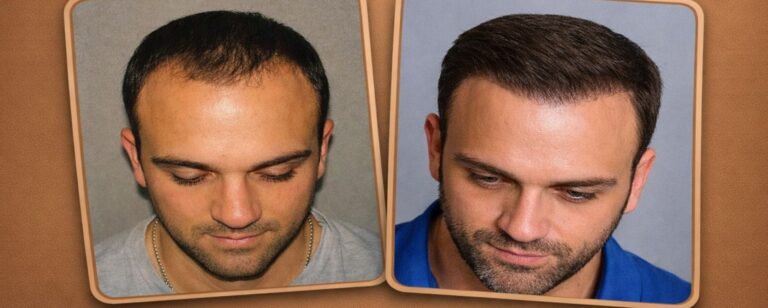
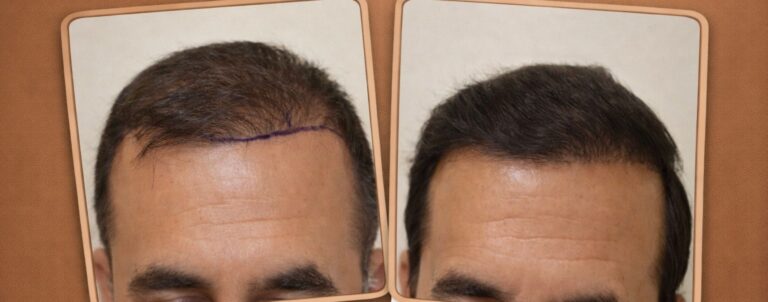
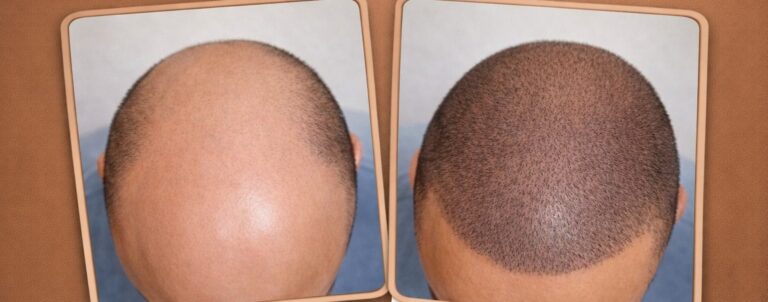
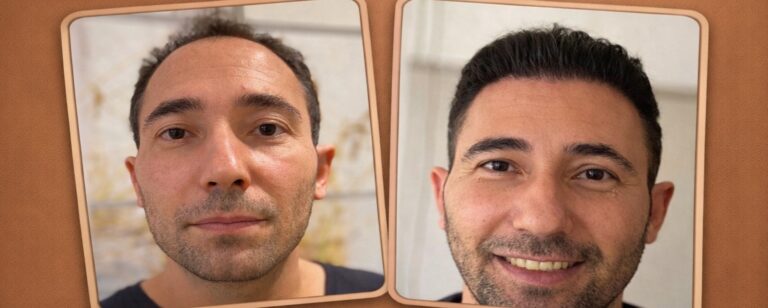
See more real patient results →
What Is Our Istanbul Location Like?
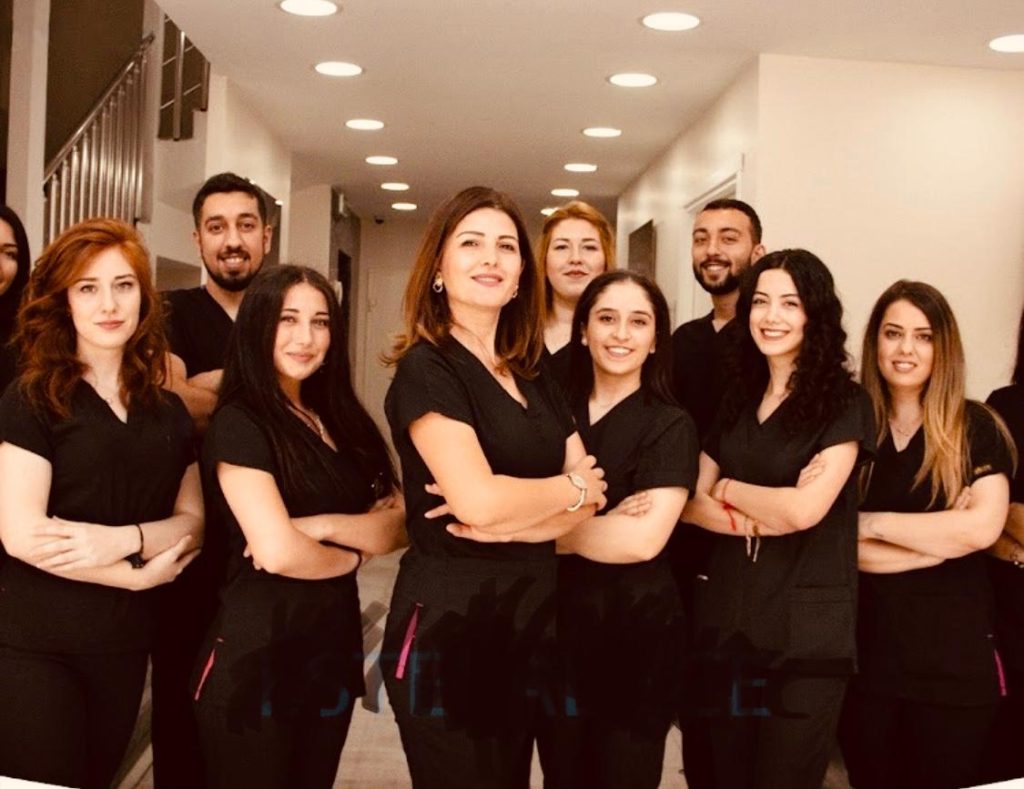
Global Health Hair is located in the heart of Şişli, Istanbul – modern, clean, and designed for a calm, private patient experience from arrival to recovery. See our full guide to the Istanbul trip.

Where Will You Stay in Istanbul?
Your all-inclusive package includes a Premium Boutique Hotel in the Şişli district of Istanbul, with modern rooms, breakfast, and a 24/7 team..




7. Frequently Asked Questions — Hair Transplant Turkey for UK Patients
1. How much does a hair transplant in Turkey cost for UK patients?
A reputable all-inclusive package costs between €1,500 and €4,000, depending on the technique and graft count. Global Health Hair packages start at €1,990 for FUE and €2,175 for DHI, including hotel, transfers, and 12-month follow-up. By comparison, equivalent procedures in the UK cost between £5,000 and £15,000 — without hotel or transfers.
2. Is it safe to have a hair transplant in Turkey?
Yes, provided you choose a clinic where a qualified MD surgeon performs the procedure, not unsupervised technicians. Turkey has a well-established medical infrastructure for hair restoration — the concern is not the country itself but the commercialised segment of the market where clinical standards are deprioritised. Verify surgeon credentials (MD degree + state medical registration number), read independent Trustpilot reviews, and ask who specifically will carry out your surgery.
3. How long do I need to stay in Turkey?
Most UK patients plan a 4-day trip: arrival, surgery day, first post-op appointment, and departure. Some patients prefer to stay a fifth day for additional rest before flying. You are medically cleared to fly as early as 24 hours post-surgery, but a two-night rest period is more comfortable and recommended.
4. What is included in an all-inclusive package?
A legitimate all-inclusive package should cover: the surgical procedure, pre-operative tests, local anaesthesia, 3 nights in a Premium Boutique Hotel, VIP airport and clinic transfers, post-operative care kit, and at least one remote follow-up consultation. If hotel or transfers are listed as optional extras, the headline price is misleading — factor in the real cost before comparing.
5. Can I fly the day after my hair transplant?
Technically yes — flying does not damage hair grafts, and cabin pressure has no effect on the transplanted area. However, most surgeons (including Dr. Merdan Çelik MD) recommend at least one post-operative review appointment the morning after surgery before you travel. A 4-day trip (surgery on day 2, departure on day 4) is the standard we recommend for UK patients.
6. Will my results look natural?
Natural results depend primarily on hairline design and angle of implantation — both surgical decisions that require an experienced MD, not a technician following a template. Dr. Çelik designs each hairline individually based on facial proportions, age-appropriate aesthetics, and the patient’s existing hair characteristics. When grafts are implanted at the correct angle and direction, the results are indistinguishable from naturally grown hair at 12 months.
7. What if something goes wrong after I am back in the UK?
This is one of the most important questions to ask before booking. Global Health Hair provides a dedicated English-speaking coordinator, WhatsApp access to the clinical team, and scheduled video consultations at one month, three months, six months, and twelve months post-surgery. In the rare event of a complication requiring in-person assessment, we coordinate with partner clinics or provide guidance on appropriate UK referrals. Clinics that become unreachable after your departure should be avoided entirely.
8. Do I need a consultation before booking?
Yes — and any reputable clinic will insist on it. A proper consultation reviews your donor density, degree of hair loss, medical history, and expectations. At Global Health Hair, the initial consultation is free, conducted via video call with Dr. Merdan Çelik MD personally, and results in a specific graft count estimate and technique recommendation before any commitment is made.
9. What is the difference between FUE and DHI?
FUE (Follicular Unit Extraction with Sapphire blades) extracts grafts and implants them into pre-opened channels — well-suited for larger areas and higher graft counts, from €1,990. DHI (Direct Hair Implantation via Choi pen) extracts and implants in a single step, offering greater control over angle and direction, no-shave options, and better results for density addition to existing hair, from €2,175. Dr. Çelik recommends the technique (or combination) most appropriate for your specific anatomy and goals.
10. How many grafts will I need?
This depends on your current degree of hair loss (Norwood scale) and your target coverage. As a general guide: a receding hairline typically requires 1,500–2,500 grafts; a thinning crown 1,000–2,000 grafts; more advanced loss (Norwood 4–6) may require 3,000–5,000 grafts. Your exact number is determined during the free consultation with Dr. Çelik, based on digital donor density analysis and a clear discussion of realistic outcomes.
Ready to Take the Next Step?
If you have read this far, you are doing the right thing: making an informed decision rather than booking blindly. The next step is a free, no-obligation consultation with Dr. Merdan Çelik MD — a genuine medical conversation about your specific hair loss, your options, and what realistic results look like for you.
No sales pressure. No commitment. Just an honest assessment from a qualified surgeon.
Book your free consultation today
Speak directly with Dr. Merdan Çelik MD · English-speaking team · No commitment required
Or email us at [email protected]
You can also complete our short online consultation form and we will be in touch within 24 hours with a personalised assessment and indicative quote.
Global Health Hair is reviewed by real patients on Trustpilot. We encourage you to read them before making any decision.
Related reading: Cost & packages · FUE vs DHI · FAQ · Real results
For this year’s pricing in detail, see our hair transplant cost guide for Turkey.
Planning when to travel? See the best time of year for a hair transplant in Turkey.
Leave a Reply